Monday, 30 November 2015
Sunday, 29 November 2015
Narrative in our opening sequence
Narrative in Our Opening Sequence
Tzvetlan Todorov- We
will be challenging his narrative structure theory as we will be starting with
a disruption. In our opening sequence we will show the wife locked up in the
cellar looking very much helpless which is how we are challenging his theory
because by starting with this disruption instead of an equilibrium, it will
instantaneously grip the audience and make them feel involved which will inevitably
encourage them to carry on watching. However the rest of the movie will follow
this narrative structure as it will help to communicate our genre
(psychological thriller) and will help the audience to understand the
storyline.
Roland Barthes- In
our opening sequence we will be incorporating an enigma code by not revealing
the identity of the husband in the opening sequence. This will add to the sense
of mystery in the plot and get the audience questioning and on the edge of
their seats as they’ll want to know the identity of this man. This is a genre
signifier for a psychological thriller as in many opening sequences of this
genre, it is extremely common for the directors to involve enigma codes as they
want to get the audience gripped and encourage the audience to watch on and
find out the answers to their questions.
The fact the husband (the antagonist) is wearing all black
is a significant semantic code, this may convey to the audience what type of
roll he will play in the rest of the movie, as black indicates; evil, mystery
and death.
Vladimir Propp- In
our opening sequence we will clearly display a villain not only by showing the
fact he has his wife locked away, defenceless, in the cellar but also the use
of the husband’s costume. This character will be wearing all black which
immediately connotes to the audience; death, evil and mystery. This also may
indicate to the audience right from the start, that he may be the antagonist.
This is very effective and conventional for a psychological thriller as mystery
is a key theme in many films of this genre.
Back-story- the
history behind the situation right at the start of our film (wife stuck in
cellar). This deepens the psychological aspect of the story since the audience
is able to more fully understand the husband; more specifically, what the
husband’s motivations are and how the current situation has shaped his current
cognitive and emotional perceptions. We are showing this through the use of a
flashback by presenting his thoughts with him talking in the background but not
actually to the camera. This will help the audience to further understand the
husband’s mind-sets and why he has his wife locked up away in the cellar.
Claude Levi Strauss- states
a good story revolves around conflict between binary opposites. This is being
displayed in our opening sequence because the two main characters, one being
the husband (the antagonist) and the other being the wife (the victim). These
two characters are binary opposites, even though they may be married, one is obviously
a woman and one is a man. The wife is somewhat vulnerable and helpless and the
husband is stronger, more independent and obviously very controlling.
Planned as a group but written by Robbie Butt
Friday, 27 November 2015
Communicating the genre of our text
Communicating the Genre of Our Text
In our film opening sequence we will communicate the genre
of our text through many ways. For example;
- Editing on the title
- Dull colours/lighting
- Enigma code
- Location
- Dialogue
- Camera shots
The editing on the title will be somewhat conventional as
there will be mainly red, black and white colours which will convey the genre
as these are common in psychological thrillers. Red connoting danger, death and
love, black connoting death, mystery and evil and white connoting innocence and
purity which not only will contrast with the black but will represent the woman
in our opening sequence.
Similarly, the colours and lighting will be just as
effective. The main colours in the opening sequence will be conventional of a
psychological thriller as dull colours are very common in this genre as they
can signify a sense of mystery. The dull colours will work in conjunction with
the low-key lighting which again is very frequent in a psychological thriller
as it can transmit the mystery to our film. There may be some more hopeful
colours such as natural daylight colours when the missing posters are being put
up as there is still a sense of hope for the sister of the missing wife as she
will only know one side to the story. But as soon as the cellar is involved,
the main colours will be dark and dull to show the contrast and how locked away
the wife is.
In terms of Roland Barthes Code Theory, we will be
incorporating an enigma code by not revealing the identity of the husband in
the opening sequence. This will add to the sense of mystery in the plot and get
the audience questioning and on the edge of their seats as they’ll want to know
the identity of this man. This is a genre signifier for a psychological
thriller as in many opening sequences of this genre, it is extremely common for
the directors to involve enigma codes as they want to get the audience gripped
and encourage the audience to watch on and find out the answers to their
questions.
Furthermore, the location of our opening sequence will be
conventional for a psychological thriller. Our main location is a cellar which
will immediately illustrate mystery to the audience and it is very commonplace
for this genre, as the most used locations for psychological thrillers are
usually abandoned as they add a sense of uneasiness and mystery within the
audience.
The amount of dialogue will be very minimal to add to the
mystery. But we are going to have a voiceover when the husband is cooking
dinner to illustrate his thoughts about what has happened and maybe hint or
even tell the audience what has happened in the past to help the audience
understand the storyline better and will help them understand why the wife is
in the cellar.
The semantic elements as a part of Rick Altman’s Genre
Theory will be incorporated through the use of the location and the wife tied
up in the cellar as these are visual iconography for a psychological thriller
and will be easy to identify for the audience. Also we will involve syntactic
elements as there are emotional themes involved such as love and also the
husband getting revenge as he feels humiliated by his wife.
The point of view shots of the wife in the cellar will
really help the audience to feel as though they are a part of the action and
help them to understand what the wife is going through. Also to make the
audience feel attached more emotionally to the character. We will also be using
an over the shoulder shot which is extremely conventional for a psychological
thriller as it is very effective in building tension within the audience. The
use of various establishing shots will help the audience to get to know the
location and maybe even establish a relationship between the location and the
characters.
Planned as a group but written by
Robbie Butt
Wednesday, 25 November 2015
Representation in our opening sequence
In our
opening sequence the main representation we focus on is gender, in many ways we
convey the stereotypical representation of men and women; men being more
dominant. However in some ways we have challenged these ideas.
In our
opening two minutes the main character is the man in our film, we portray him
as very dominant compared to the woman, and we do this by the story line being
the man keeping the woman hostage and not the other way round. We also support
the idea that men are the more violent and strong gender as although we don’t
show any fighting or arguing in the opening sequence, we make it clear that he
has forcefully trapped her in the cellar to punish her. However one way we
challenge the stereotypes of gender is by the woman being the unfaithful one
whereas typically the man would be suspected as being disloyal. The camera
angles will support the idea that men are more powerful as we will use a
low-angle shot looking up at him to over exaggerate his height and dominance
also showing he has control over his wife. Another representation of males is
that they’re mysterious and have something to hide and we will show this
firstly in camera angles and lighting where we won’t show his whole face until
the end, hinting to the audience that he has something to hide, additionally
his outfit will be black which is associated with mystery. In the opening
sequence the audience can see that he feels emasculated by something that the
wife has done, and our opening supports the idea that when a man feels
emasculated he then has to then do something to get his masculinity back and
prove a point that he’s still more powerful. On the other hand another
challenge we include is a more sensitive side to him as an idea we have is to
include a flash back voice in his head of an argument they had about the affair
which could suggest that what she’s done is on his mind and is upsetting him
more than he’s trying to show. Our film suggests a patriarchal society.
On the other
hand, the woman in our opening sequence will be represented as much less
dominant as she’s being trapped and isn’t strong enough to get out. She
supports the idea that woman are more scared than men and therefore weaker by
the sound of her heavy breathing and her makeup being smudged showing she’s
been crying in the cellar. Camera angles will be used to make her seem
vulnerable and weak as we will use high angled shot looking down on her. We
support the idea that men aren’t allowed to disobey men as she’s been unfaithful
to him and now she has to be punished in a brutal way and suggests that if
she’s not with her husband then she can’t have a relationship with anyone,
whereas if a man cheated she wouldn’t have the strength to punish him in this
way, making it seem okay for him but not for her. She is portrayed as a
submissive character as she must obey him otherwise this is what happens. This
character however challenges the idea that women obey their husbands at all
times and we show her promiscuity through her costume which is a red top which
is associated with love.
Planned as a group, written up by
Jessica Granger
Monday, 23 November 2015
Costume and prop list
Costume and Prop List
Props:
Street: A specific alleyway just for
pedestrians which is very effective as people have a higher chance of seeing
the missing posters, stopping, reading them and then they have an understanding
of the missing girl.
- Missing posters/blue tac
- Lamp post/trees
Kitchen:
- Pan
- Hob
- Food
- Plates
- Cutlery
- Table
- Chairs
- Laptop
- Printer
- Missing posters
- Newspaper
Cellar: A creepy/eerie/mysterious looking
cellar which is conventional for our genre (psychological thriller).
- Chair
- Bucket
- Rope
- Dirty plates
- Torch
- Food
Costumes:
James Potter:
·
Black
t-shirt
·
Black
jeans
·
Black
desert boots
The all
black outfit will illustrate; death, evil and mystery. These are all key themes
in psychological thrillers and will help the audience to understand the
character and maybe even figure out straight away from the outfit, that he is
the antagonist.
Megan Potter:
·
Red
top- to connote love, death, blood and maybe her promiscuous side as red can be
quite a sexual colour.
·
White
skirt- indicating her purity and innocence.
·
No
shoes- to emphasise how isolated, helpless and hopeless she is as she is stuck
alone in a cellar with as it seems, no help.
·
Smudged
make up- to show how distraught and helpless she is because as much as she
cries, there may be no hope for her in the end. Maybe to also show how long
she’s been stuck down there.
·
Ring-
to emphasise that she is married to the man and that even in this horrific
time, she is still wearing it.
Abigail Granger:
· Pink blouse- smart/office style top to show the nature of her job. Pink to represent the love and care she has for her sister and make her look like an innocent, feminine character
Black jeans - add a sense of mystery to her character as in the opening the audience are unaware of the part she will play and her role (as the protagonist)
White shoes - show her innocence and purity
Black jeans - add a sense of mystery to her character as in the opening the audience are unaware of the part she will play and her role (as the protagonist)
White shoes - show her innocence and purity
Planned as a group but written by Robbie Butt
Saturday, 21 November 2015
Locations recce
Locations Recce
There will
be three main locations within our opening sequence:
1.
street/alleyway
2.
kitchen/modern house
3. cellar
Firstly,
we want to use a street or alleyway to show the sister and husband putting
up missing posters of the woman. We want to present them putting them up in a
public area as obviously they will want people looking out for the missing
woman. This will be our second scene.
The restrictions
for using this area is that it is a public area so we will need to be careful
when filming to not get any pedestrians on camera as they may not give us
permission to use the footage. Another restriction is the fact that this
area is a large open space and is fairly windy. Therefore it will be hard to
hear any dialogue from the characters and there will also be
the sound of the wind during the footage. As a result we will need to put
music and the dialogue over the footage and record it separately and mute
the sound on the actual footage. There is also a lack of power points so
we will have to work with the natural lighting and make sure the camera is
fully charged before we go out to film so we don't run out of battery half
way through! As it is starting to get dark early we will film at around
2/3pm so it is still light enough to film and get good results. The health
and safety issues is the road that is next to the alleyway. It isn't
a very busy road but we will make sure we are on the pathway at all times and
stay clear of cars.

The second
location is the kitchen and modern house. This will be where we film the first
and third scene of our opening sequence. The husband will be seen printing
off missing posters in the first scene and then making dinner for him in the
third scene.
The
dangerous hazards will be when cooking the meal. The gas hob will be on
and we will need to be careful when filming to remember to stay clear of
it and be sensible. There is also a mirror on the wall opposite the kitchen so
when we are filming the husband cooking we need to be careful to not get
reflections of any of the equipment or people!

The third
and final location is the cellar. This is where we will be filming the final
scene of the opening sequence. The wife is being held hostage in here and is
tied up to a chair.
The
colours of the cellar are perfect as they are generally dark colours.
This signifies the mind of the husband. As black is a mysterious
colour associated with fear and the unknown. The dark colours are
used to create fear and suspense and ultimately scare the audience.
There was
another option of a cellar but we had to rule that one out as it was cramped
with too many items. The height of the ceiling was also too low so
therefore it would not be suitable to film in. The fact that this cellar is
very clear and empty will help to make the wife seem isolated from society and
an outsider.
Thursday, 19 November 2015
Our script
Our opening sequence script
INT. Desk – daytime
JAMES is at his desk
on his computer printing missing posters with his wife on them. Only the back
of his head is shown.
He clicks print on
his computer.
A shot of the
printer, JAMES reaches his hand out to take the printed poster.
INT. Dining room –
daytime
A shot of the table,
a newspaper is thrown by JAMES, the camera films the newspaper and the hand,
not JAMES.
Panning shot of
framed photos of JAMES and MEGAN as a couple.
JAMES is stood in
the dining room, there’s a knock on the door. It makes him jump and he gasps
suddenly
INT. The front door
– daytime
JAMES opens the
door, ABIGAIL is stood outside.
ABIGAIL
Should we go?
JAMES nods.
JAMES and ABIGAIL
walk out the door.
INT. A street –
daytime
JAMES and ABIGAIL
put a poster up on a tree.
They walk away.
INT. Front door -
daytime
JAMES arrives home
and opens his front door and walks in
INT. Kitchen -
evening
JAMES serves up two
plates of dinner
INT. dining room
table - evening
JAMES puts food down
and sits down at the head of the table
Whilst eating he
hears flashbacks of arguments that occurred between him and his wife
His facial
expressions are angry and frustrated.
JAMES
Who is he?
How long has this been going on?
MEGAN
I’m sorry
I still love you
Please don’t leave me
(the flash back will be distorted and the
lines of dialogue will be repeated)
He takes his last
spoonful of dinner
He stands up and
picks up the extra plate of food he made
INT. Outside -
evening
He goes out the door
and walks down the stairs outside and unlocks the door
INT. cellar –
evening
He enters the cellar
holding a torch and the plate
MEGAN breaths heavy
JAMES walks closer
towards MEGAN
JAMES
Did you miss me?
Did you miss me?
MEGAN struggles to
get out of the chair
This is the script for our opening sequence; it is mainly
stage directions for the actors as we didn’t want to include much dialogue in
our opening sequence to add to the suspense. However as mentioned in past posts
this is a factor of our opening that we will try out and decide if it works
when we come to edit. I have still included them in the script.
Planned as a group, written up by
Jessica Granger
Tuesday, 17 November 2015
Our storyboard
Our opening sequence storyboard
Here is the storyboard, which are the scenes we plan to
shoot for our opening sequence. We’ve planned to try out the scenes with
dialogue however for a number of reasons we may not include them in our final
piece, these reasons include the possible poor acting skills or if they don’t
work and make the film less believable. Throughout the opening there will be
non-diegetic music playing which only cuts out when the screen goes blank, as
written on the storyboard at times the music changes like when James enters the
cellar and when the title of the film comes up. I was unable to write the real
title of our film when drawing the story board because we are still undecided
however obviously where it says ‘TITLE’ that’s when it will come up. Also the
amount of scenes may chance if cutting from one to another look unnatural we
may have to include an extra scene in the middle, these are things we will only
be able to judge when we begin to film the opening sequence and/or when we
begin to edit.
Planned
as a group, written up by Jessica Granger
Sunday, 15 November 2015
Film idea
Group Film Idea
Film
Title: The Vault
The
vault is another word for cellar and as the majority of the film is based in
the cellar our group thought it would be effective if the title connected to
the main theme of the film.
Genre: Psychological
thriller
Psychological
thriller is a thriller story, which emphasises the psychology of its
characters and their unstable emotional states. In terms of
classification, the category is a subgenera of the broader ranging
thriller category, with similarities to detective fiction
in the sense of sometimes having a "dissolving sense of reality",
moral ambiguity, and complex and tortured relationships between
obsessive and pathological characters. Psychological thrillers often
incorporate elements of and overlap with mystery, drama, action, and horror,
particularly psychological thriller. Our group narrowed down
the genre to a psychological thriller due to the fact that it is a mystery
film. As throughout the audience is trying to work out how and why the woman is
down in the cellar. Our film also presents the unstable mentality of
characters, through the use of editing, dialogue, mise en scene, body
language and camera angles.
Age
Rating: 15
Our group classified our film as an age 15 rating. Within the
film there will be frequent strong language and strong violence. This is
not suitable for anyone under the age of 15 as it is inappropriate.
Although, on the other hand, there will be minimal sexual activity due to the
fact that our film is based on a bad relationship between a husband and wife
and therefore neither will be encouraged to do so. An age 15 rating includes
any of the following:
·
Strong violence
·
Frequent strong language (e.g. 'f***')
·
Portrayals of sexual activity
·
Strong verbal references to sex
·
Sexual nudity
·
Brief scenes of sexual violence or verbal references to sexual
violence
·
Discriminatory language or behavior
·
Drug taking
Characters:
In our film there will be a relatively small number of
characters so it gives the audience a chance to connect and engage
with them. This will help to build a strong perception of what they are
like.
Megan Potter - (played by Freya Money)
Megan is a sensitive, quiet, young woman (25 years old) who has a
secretive, mysterious side to her personality that the audience is
striving to see. Megan is very submissive and bows down to any man as she is
too afraid of getting hurt. Megan was happily married but in the film is seen
as the victim and being held hostage in a cellar by her own husband, this
is because she cheated but the audience are yet to find that out
until further on in the film. Our group chose the name 'Megan' as it is the
most promiscuous name and we want their names to reflect who they are. Her job
is a personal assistant; she met her husband through her job,
again this reflects how she is submissive to men as her job is being
told what to do by a man. She also met the man she cheated on through her job
as well.
James Potter - (played by Robbie Butt)
James is a dominant, stereotypical male character who always has to be in
control, especially of women. He is a middle aged man (36 years old). He
has a strong personality, he is confident and very proud to be who he has
become. This makes him turn to a psycho when he finds out that he wife has
cheated on him. He feels emasculated and he believes by punishing his wife
he is gaining is masculinity back. James is the manager of
a forensic investigation company and therefore is very knowledgeable in
covering up crimes! He is the antagonist in the film - the main character as
the film follows his unstable mindset and the consequences of it.
Abigail Taylor - (played by Jess Granger)
Abigail is a concerned older sister of Megan who is always thinking of others
before herself. She is very naive and involved in journalism so is
very interested into discovering new things and investigating.
Throughout the film she tries to discover what has happened to her sister. She
is the protagonist in the film as she is eventually the one to find and save
her sister from the psycho, mental husband. It is a battle between the two
of them.
Location/Setting -
The main location is the cellar and in the house where James and
Megan live. Our group has chosen to use my house (Freya Money), as it is modern
and fairly new, as that is what we want the representation to be of the
couple. There are two options for the cellar, but are both very dark and
mysterious to create the perfect atmosphere for the film. In which case we will
carry out a locations recce to see which cellar is most suitable to work
and film in.
Storyline -
The
film will firstly be subjective filming throughout the opening sequence and the
majority of the film as the story will be told through the husbands eyes. Used
to enhance a sense of realism and audience involvement in the action. It is
also being used to hide the identity of the husband to create tension and
suspense within the audience.
A
woman has recently gone missing who is in her late twenties. She has a husband
and a very loving family who are all devastated about her death. The husband is
first seen printing off missing posters and is then met by his sister in law to
put them around the neighborhood. The husband makes his way home. The
atmosphere is quiet and empty. Extreme long shots of him to connote how alone
and lonely he is. Husband makes dinner for himself but makes two plates of
food. Is it just routine?... Habit? Is he just missing his wife
dearly and accidently made her a plate a food thinking she is still
there? Husband walks downstairs with the plates of food. Over the
shoulder shot and POV shot of wife looking at a door. Everywhere looks
dark. Door opens, the husband walks in. Harsh light pours through the
door. Husband chucks plate of food and non-diegetic, mysterious, eerie
music begins to play. Credits appear… Throughout the rest of the film, the
sister of the missing woman tries to discover how her sister has gone missing.
Digging down into unintentional clues left behind by the husband, she gets
closer and closing to her goal of finding her. But as the tension rises so does
the psychotic mentality of the husband. The sister finally gets into the cellar
where her sister has been held hostage but the husband, James, catches her and
locks them both up. But the sisters think of a plan to kill the husband the
next time he comes in and they get away and are able to put the horrific
experience behind them and move on with their lives without him.
Planned
as a group but written by Freya Money
Wednesday, 11 November 2015
Description of target audience
Age:
15-35 years old, we chose this because within the film there will be some strong language and violence. This would be inappropriate for children under the age of 15 and although people over the age of 35 are able to watch we chose this age as we feel it is mostly to watch and enjoy this type of film.
Gender:
We feel that both males and females will enjoy this film, males may relate and enjoy it as the main character is male however the male character is also the antagonist and the male audience may not like their gender being represented in this way. Women may enjoy it as the protagonist is a female and they could sympathize more with the character of the wife as they would understand how hard her position must be.
Social demographic:
C2, D, E. This is because our target audience is younger people so therefore most will either be unemployed and in education or have part time jobs and perhaps not be earning as much as older people.
Occupation:
To link with the social demographic target audience I would say jobs such as shop workers, manual workers such as builders etc.
Hobbies and interests:
Perhaps people with in interest in thriller movies, psychology or crime. Also people that like to be gripped by a film as our film is in some ways a mystery and they would have to watch until the end to find our what happened.
Personality:
I would say someone quite curious as they would be gripped by the mystery and watch on to find out what happened and also someone sympathetic as they may feel sorry for the wife and want to watch on to make sure she makes it out of the cellar.
Uses and gratifications:
The audience will escape from their every day life and get involved with the characters lives and they will also be entertained and gripped at the plot of the film.
Saturday, 7 November 2015
Friday, 6 November 2015
Analysis of opening sequence: Black Swan
Black Swan
The music used in this scene is
classical to again highlight the dancer she is, I would say this piece of music
is dramatic from the start, however then gets even more dramatic and quicker
paced. She projects sounds of heavy breathing as he enters the performance and
gasps to portray the fear the man has caused. The music reaches its climax when
the pair are dancing together, showing this is an alarming occurrence. The use
of the change in music grips the audience and makes it the comparison in the
characters evident. Once the man leaves the stage the music gets slower and so
does her dancing and almost goes back to how it was before he joined the dance,
showing that his exit caused her to calm down.
The costumes used create a clear
contrast between the characters; firstly dressing the female in white suggests
her innocence and purity, whereas the man is dressed in black which is a
representation of the mystery of him and possible how evil he is. Mid dance
there is a costume change, both characters are dressed in feathers, again the
female is in white to show she’s the good character and the man is in black to
show he’s evil. The man is also in a sort of monster costume with horns which
could also link to evil as monsters aren’t normally good. The colour difference
could also be linked to the representation of gender in the film, the men could
be the antagonists and the women could be protagonists, this is not known by
the opening sequence only suggested. Lastly the opening sequence leaves many
questions for the audience and narrative enigma codes like ‘why’s he evil?’ ‘who
is he?’ ‘why’s she scared of him?’. Most of these questions being based on the
man as he is the more mysterious of the two and less of his identity is shown
in the opening.
Thursday, 5 November 2015
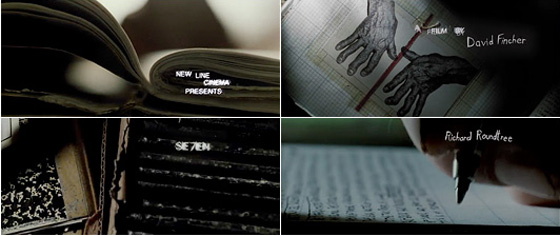
Analysis of opening sequence: Se7en
Se7en
Sound is use effectively in the opening as throughout I would
say the non-diegetic sound played is uncomfortable and hard for the viewers to
listen to, this suggests that for some people watching the scenes of the film
will make them feel uncomfortable as they will be quite graphic and brutal. The
music is also very suspenseful with quite a heavy pitch and the speed also
increases slightly as the opening credits end building up the tension. There
are also higher pitched sounds which relate to screams, showing the genre again
as screams are associated with pain.
Camera angles are close up throughout, for the audience this
would make them feel more involved and apart of the film, making them feel
uncomfortable again. The close ups also show detail for example the cutting of
his fingers to get his finger prints off is showed in a lot of detail and would
possibly make this difficult for the audience to watch, again showing what the
film will be like. There are no long shots in the opening as this would give
too much away about the person; they’re not shown in the opening to add suspense
and enigma codes for the audience. It’s gripping as the audience will carry on
watching to find out who they are, what they’re doing and why.
In terms of editing, the shots are slow paced at the beginning
which hints at what they’re doing as we get a good shot at some of it like what
they’re writing however we still don’t understand adding curiosity. The more
fast paced shots are suspenseful as we may miss bits of the plot or some clues.
The blurriness and shaking of the credits could suggest the person’s mental
state, perhaps he’s mentally unstable or has unstable thoughts, showing maybe
he enjoys causing pain and this isn’t the first time it has happened.
Wednesday, 4 November 2015
Conventions of an opening sequence
Credits
The credits of the film introduce the actors and
actresses, this could make the film more engaging for some people if an actor
they particularly like is in the film. The colours and sounds used in the
credits are used to show the genre of the film before it has even begun.
The titles not only show the name of the film but like
the credits are also used to show the genre, the font, colours, images and
sounds all hint what kind of film it will be.
Logos
Not only do the logos inform the audience about which
company made the film, the logos can also be used to represent the genre of the
film as different effects and colours can be used. An audience recognising a well known company will make
them want to carry on watching as they may know the company have produced good
films in the past.
Introduction of characters
In the opening sequence of the film we get our first
glimpse at the characters and how they will be represented in the film. This
will either make the audience like them or they’ll know they’re be the
antagonist. The way characters are portrayed in the opening may
change throughout. The characters are there to engage the audience as they want
to keep watching and see what happens to them.
Sounds
Sounds in the opening sequence also hint at the genre
for example in the film jaws very suspenseful music is used to build up the
tension before the big event happens. Silence is also an effective part of opening sequences,
perhaps to emphasise the difference between the scenes with sound and make them
look more frightening. Sounds such as screaming show the genre is horror and
the effect of what’s going on or laughter tells us the film genre is a comedy.
Narrative enigma
Narrative enigma codes are unexplained events that
happen, they are used in the opening sequence to engage the audience, they want
to carry on watching to find out why that happened or what’s yet to happen.
They make the audience question the situation and want to know more.
Location
Setting the scene in the opening informs the audience
where the film will be set, it also shows genre as for example if the location
of the opening is a scary woods its likely the genre is a horror. It could also
tell us about the people in the location as it may be their home or workplace.
Mis-en-scene
The mis-en-scene of the opening sequence is the factors that
tell us what’s happening and the genre, for example a person In a mask will
tell us its a horror and that they are the villain.
Subscribe to:
Posts (Atom)